Knife Crafting in CS2: Can You Really Profit or Is It Just Risk?

Knife crafting in CS2 is based on trade-up contracts, where players exchange a set of skins for a chance to obtain a rare knife. You invest a certain amount of money and rely on probability rather than skill. It is not a direct crafting system, but a gamble driven by random outcomes.
After recent CS2 updates, knife crafting has become popular again. The market is experiencing strong price fluctuations, new cases and collections have appeared, and knife values have shifted.
Many players now see crafting as a potential way to make profit, influenced by isolated success stories from streams and social media. This creates a false sense of easy money, while in reality the system remains highly risky. That is why understanding the math and real drop chances is essential before attempting knife crafting. The xplay.gg team is here to help you understand the topic.
How Knife Crafting Works in CS2
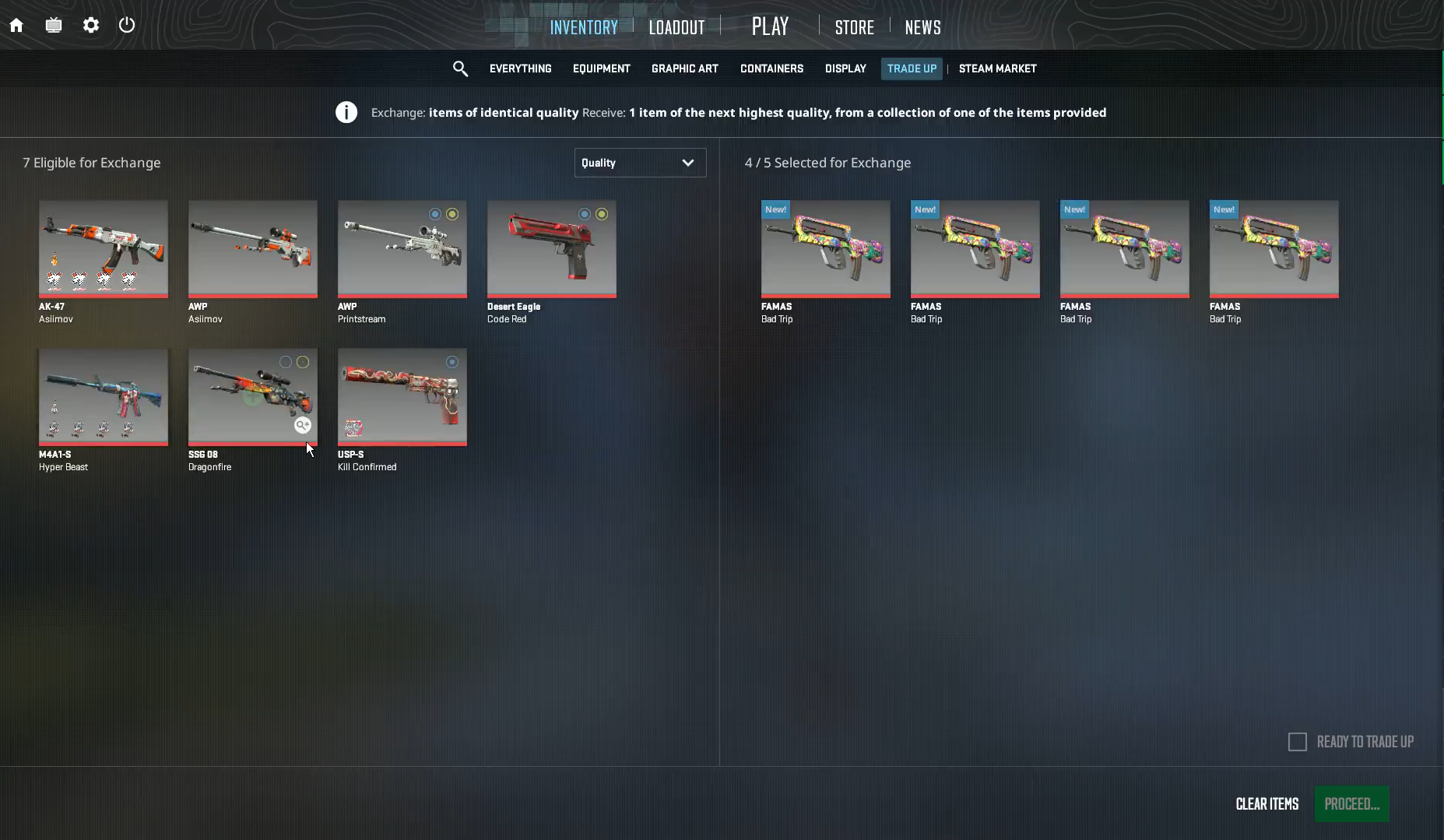
Knife crafting in CS2 is basically an upgraded version of trade-up contracts. You trade in several high-tier skins and get one random item of a rarer grade. A knife is a possible outcome, but it’s never guaranteed.
The system is entirely based on trading rather than traditional crafting. There’s no way to influence the result during crafting — everything is decided by preset probabilities.
To try your luck at crafting a knife:
- You need 5 Covert (Red) rarity skins;
- All items must be of the same type: either normal or StatTrak — you can’t mix them;
- Souvenir skins or items of other rarities don’t count in these contracts.
CS2 Skin Rarity Levels
CS2 has a clear rarity chain that trade-up contracts follow:
- Consumer — Grey
- Industrial — Light Blue
- Mil-Spec — Blue
- Restricted — Purple
- Classified — Pink
- Covert — Red
- Knives or Gloves — Gold
Each trade-up contract only increases the rarity by one level. This means knives and gloves can only drop from trading Covert skins — there’s no other way to craft them.
How the Final Item is Chosen
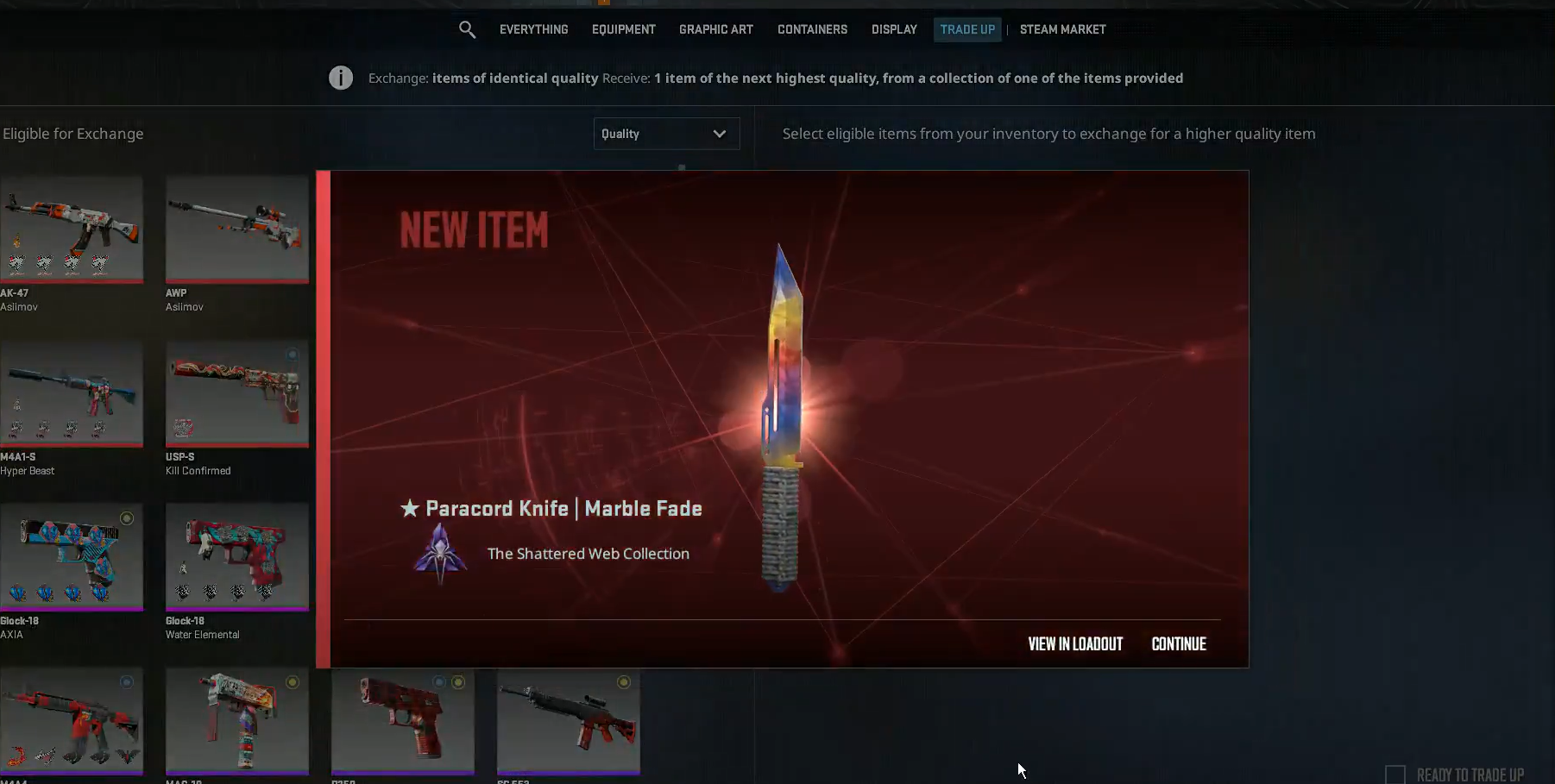
The output item is picked randomly from the collections of the skins you put in.
Important: the collection a knife or gloves comes from is randomly chosen among the collections you used.
For example, if you trade skins from the Fracture and Prisma 2 collections, the resulting knife will belong to one of those two collections. The chance of each depends on how many skins from that collection you included in the contract.
That’s why picking the right skins actually matters — it affects your odds, but it still doesn’t give you full control over what you get.
What Determines the Outcome of a Knife Craft
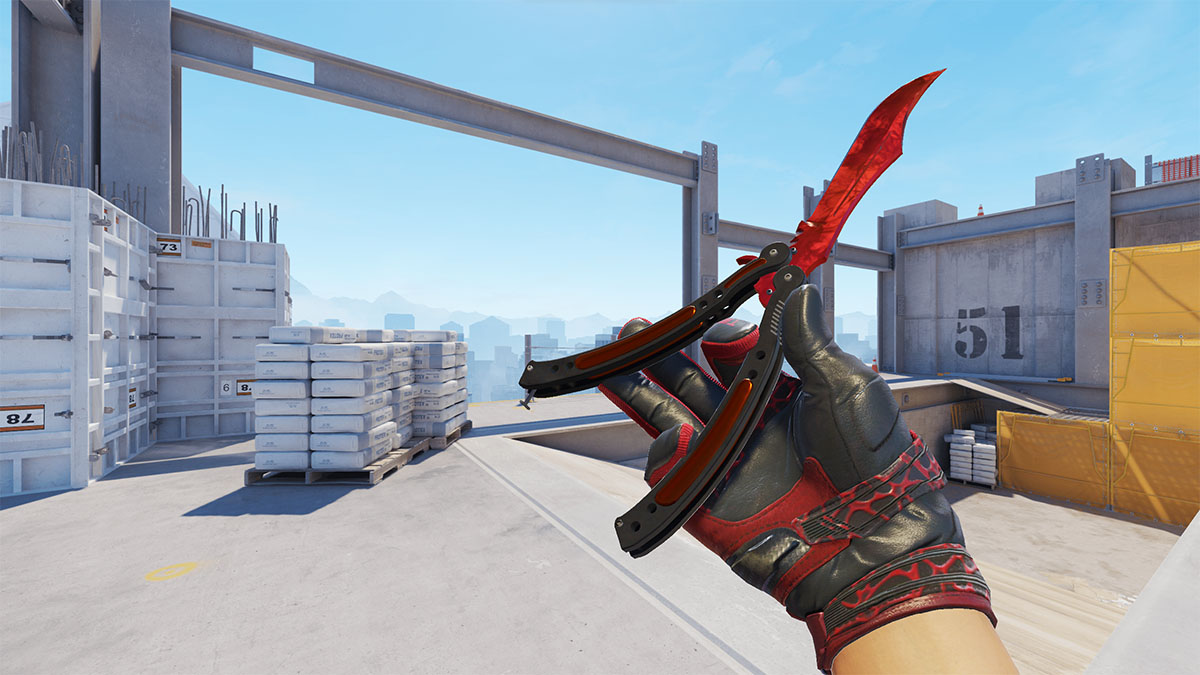
The result of a trade-up contract in CS2 is never guaranteed — it’s always determined by randomness and probabilities. Even if you assemble the “perfect” set of skins, the final item is still chosen randomly. That’s why the knife or gloves you want can never be 100% certain.
Chances are determined on two levels:
- Choosing the case the output item will come from: If you use skins from multiple collections, the chance of the final item coming from each collection is proportional to the number of input skins from that collection.
- Choosing the specific knife within that case: Every knife or pair of gloves has equal odds inside the collection pool. For example, if there are 30 unique knife-and-finish combinations in the pool, the chance of getting any one of them is roughly 3.33%.
Example
A player has five red (Covert) skins:
- Desert Eagle | Printstream (Field-Tested)
- AK-47 | Legion of Anubis (Field-Tested)
- AK-47 | Bloodsport (Minimal Wear)
- Glock-18 | Bullet Queen (Field-Tested)
- M4A1-S | Player Two (Minimal Wear)
They add these five skins to a trade-up contract and confirm the exchange. From this point, they can no longer influence the outcome — the system takes over.
First, the game randomly decides which collection the final item will come from. Since the input skins are from different collections, each collection gets its share of probability. In this example, there are three possible cases: Prisma 2, Spectrum, and Fracture.
Then, the system picks the specific item from that collection — for example, an Ursus Knife | Marble Fade or Butterfly Knife | Damascus Steel. Finally, the float is calculated automatically based on the wear of the input skins.
You can read more about skin wear in CS2 in our article: CS2 Float Guide: What is it?
Understanding Costs and Potential Value
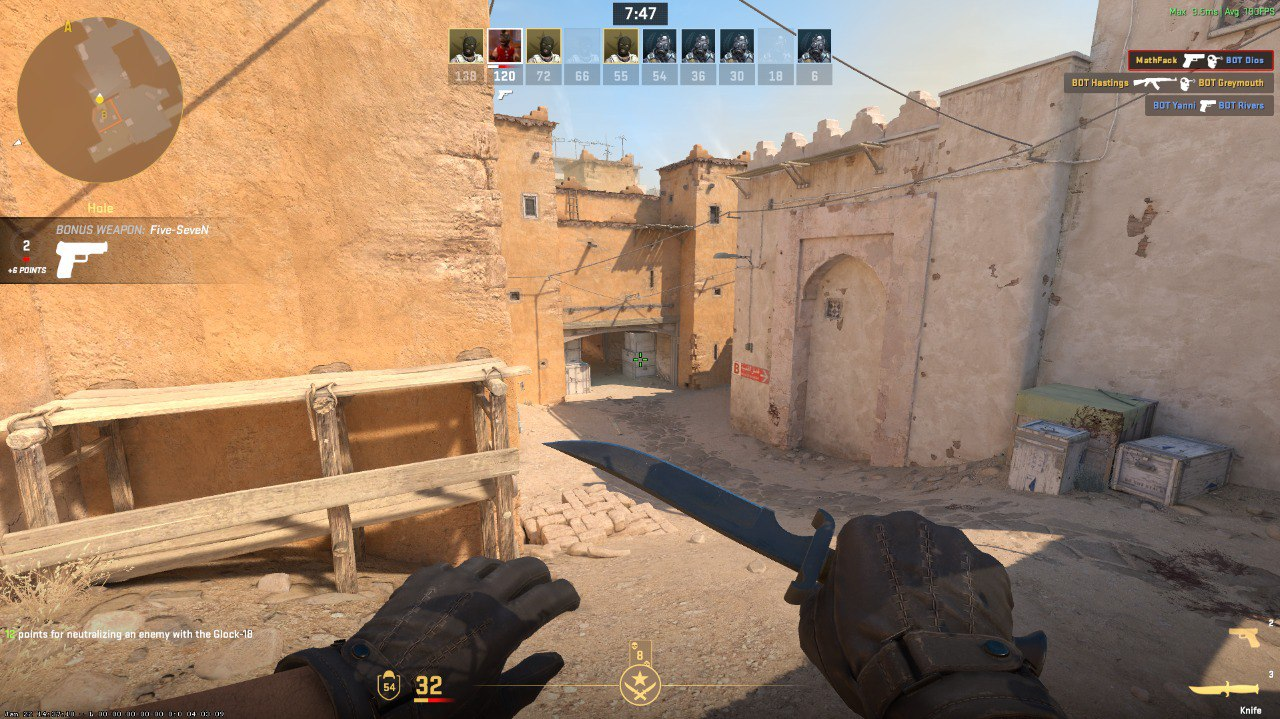
Every crafting attempt costs money, and the final item could be a rare jackpot or just a visually cool skin that’s hard to sell for a high price. So before crafting, it’s important to know how much you’re willing to spend.
Expensive input skins don’t guarantee a pricey knife:
- Buy vs. sell price: You could spend a lot on input skins, but the resulting knife might sell for less than what you spent.
- Market unpredictability: The same knife can go for different prices depending on supply and demand.
- Lower liquidity: Knives are harder to sell quickly than regular skins — even rare ones sometimes sit on the market.
Before jumping into trade-up contracts, compare:
- The cost of the five Covert skins you’ll use.
- The average value of potential output knives.
- The probability of getting the item you actually want.
Sometimes, it’s just easier and safer to buy the knife directly from the marketplace.
Is Knife Crafting in CS2 Profitable?
To be honest, any crafting that involves money is always a risk, and crafting knives and gloves in CS2 is even riskier. It can be profitable, but only in very specific cases — most of the time, players spend more than they make.
Yes, theoretically, you could turn a profit if you assemble the perfect set of skins, pick the right collections, and manage to get a knife or gloves with high demand. But statistically, only 20–30% of crafts actually end up profitable.
To understand if a contract is worth it, pay attention to these points:
- Expected Value (EV): The average “mathematical” value of the contract’s outcome, taking all probabilities into account. If the EV is lower than your costs, the contract is losing money.
- Break-even point: The total cost of input skins at which the average output price equals your investment.
- Best and worst-case scenarios: The best-case is getting a high-value knife, while the worst-case is ending up with a regular skin worth less than what you spent.
How to Calculate Chances and Expected Value Before Crafting
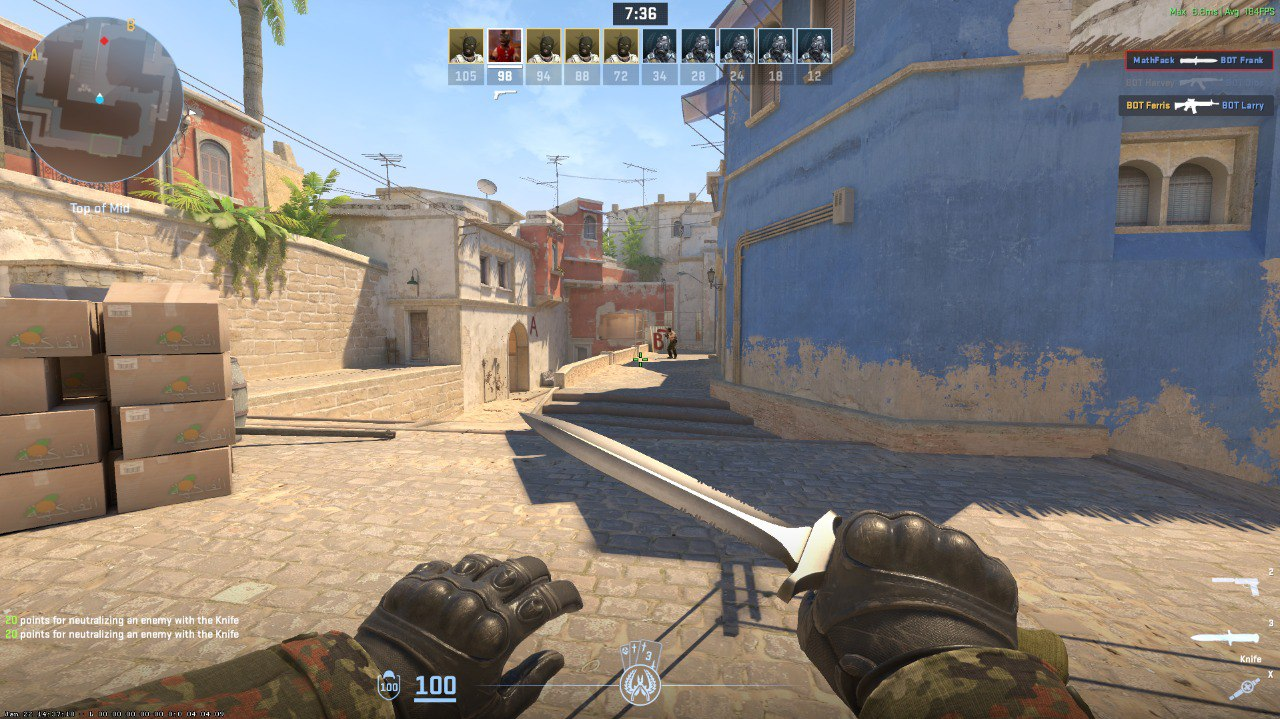
Before trying knife crafting in CS2, it’s important to understand the math behind the contract. This isn’t just about guessing or luck — it’s about making informed decisions and calculating risk.
How Players Calculate Expected Value (EV)
EV is the average value of the outcome if you were to repeat the contract many times. To calculate it, you need to know:
- Cost of input skins — how much you spend on one contract.
- Prices of possible outcomes — the market value of all knives or gloves that could drop.
- Probabilities for each outcome — the chance distribution based on the collections of your input skins.
The formula for EV looks like this:
EV=∑(probability of outcome×item price)
To actually calculate it, you’ll need:
- A list of your input skins and their prices
- All possible knives or gloves from the chosen collections
- Market prices for these items
- The number of skins from each collection (to determine probability weights)
Step-by-step:
- Sum up the cost of all input skins — that’s your real expense.
- Identify the market price of all possible output items.
- Calculate the probability weight for each collection, multiply by the price of each item, and sum everything — that’s your EV.
If the EV is higher than the input cost, the contract is theoretically worthwhile. If it’s lower, you’re risking a loss. This method turns crafting from a gamble into a calculated decision.
Even if you feel “lucky,” randomness doesn’t change the average value of the contract. EV helps you see whether it’s worth the risk and estimate how likely positive or negative outcomes are.
Example of Calculating Chances and EV
Let’s say a player has 5 Covert skins:
- Desert Eagle | Printstream (Field-Tested) — $36
- AK-47 | Legion of Anubis (Field-Tested) — $35
- AK-47 | Bloodsport (Minimal Wear) — $160
- Glock-18 | Bullet Queen (Field-Tested) — $58
- M4A1-S | Player Two (Minimal Wear) — $60
Total input cost: $349
Next, let’s look at a simplified example where the player calculates what they might get:
Probabilities are distributed proportionally to the number of skins from each collection. For example, if we have 3 skins from the Spectrum collection, 2 from Prisma 2, and 2 from Fracture, the chances are 43%, 28%, and 28%, respectively.
EV=(0.43×900)+(0.28×400)+(0.28×300)=387+112+84=583$
Here, the EV ($583) is higher than the contract cost ($349), meaning the contract theoretically has a positive expected value.
But remember: this is an average value, not a guarantee. In practice, you might still end up with a knife worth $100.
To increase your chances of crafting a rare and valuable knife, use Covert skins from collections that contain high-demand knives. The most recommended collections for knife crafting in the new CS2 Trade-Up system are:
- Fracture
- Dreams & Nightmares
- Prisma 2
- Revolution
- Recoil
These collections are popular because they include high-value knives like Butterfly Knife, Skeleton Knife, and Karambit.
Risks, Limitations, and Common Mistakes
Knife crafting in CS2 can be exciting, but players can lose money if they don’t account for all the factors.
What risks do players usually overlook?
- Randomness (RNG): The final knife is chosen randomly. Even perfect input skins don’t guarantee a high-value result.
- Market volatility: Prices for knives and skins can drop sharply after new case releases or updates.
- Fees and commissions: The marketplace takes a cut from sales, which reduces actual profit.
Common Knife Crafting Mistakes and How to Avoid Them
1. Using skins from different collections
- Mistake: Throwing skins from multiple collections into a contract, hoping for a specific knife.
- Tip: To maximize your chances of getting the knife or gloves you want, use all 5 skins from the same collection. This ensures the output item will come from that collection.
2. Ignoring case contents
- Mistake: Picking skins randomly without checking which knives or gloves are possible from that collection.
- Tip: Study the collections before crafting. Some cases only contain one knife type, so the result can be predicted almost entirely.
3. Poor economic evaluation
- Mistake: Expecting profit without comparing the cost of input skins and potential outcomes.
- Tip: Before crafting, do a quick check:
- Sum up the cost of the five Covert skins going into the contract.
- Calculate the average price of possible output knives.
- Factor in the probability of getting the desired item. Sometimes, it’s simply safer and easier to buy a knife directly on the marketplace than to risk money.
4. Ignoring float and collection restrictions
Mistake: Using skins with unsuitable wear or from collections without knives, hoping for luck.Tip:
- Check the float (wear) of input skins — it affects the final knife’s float.
- Don’t use Souvenir skins, they don’t count in trade-ups.
- Make sure your chosen skins are from collections that actually contain knives.
Knife Crafting VS Buying a Knife Directly
When comparing knife crafting in CS2 to buying a knife from the market, the key difference is predictability. Buying gives you full price transparency and a guaranteed result. Crafting, on the other hand, is based on random outcomes with no certainty of getting the knife you want.
Crafting may appeal to players who enjoy risk-based mechanics and understand the math behind trade-up contracts. This usually includes traders, skin enthusiasts, or players experimenting with probabilities. For them, knife crafting is more about the process than guaranteed profit.
Buying a knife directly is the smarter option if your goal is to own a specific skin or pattern. You avoid randomness, save time, and control your budget. For most players, purchasing from the Steam Market or third-party sites is the more efficient path.
On the xplay.gg blog, there’s an article about knives that won’t break the bank: TOP-8 Cheapest Knives in CS2.
Is Knife Crafting Gambling or Strategy?
Crafting knives in CS2 is always tied to luck — you can’t completely remove the gambling element. Every trade-up contract is like a roulette spin: you pick your skins, but the outcome depends on probabilities, not on how badly you “want” a knife. In essence, knife crafting is more like a risky bet than a fully controllable process.
However, with the right approach, it can almost turn into a strategic game. Players look at the price of input skins, the chances of getting certain knives, and the market value of possible outcomes. Randomness is still there, but this method helps you understand what to realistically expect and what level of risk you’re willing to take.
Here’s an example to illustrate:
A player throws in 5 Covert skins from random collections hoping to get a knife. They’ve seen streams where someone pulled a Karambit and decide to give it a shot. In the end, they get a regular knife worth less than what they spent. There’s no analysis of odds or prices here — it’s just a gamble on luck. Then they try again with another 5 random skins — again, just a bet on chance.
Another player carefully selects 5 Covert skins from a single collection they actually want a knife from. The average cost isn’t high, so even a budget knife could justify the investment. The result: the knife may drop — or it may not — but the decision is based on calculation, not emotions.
FAQ
Can beginners try crafting a knife?
Yes, they can, but remember — it’s always a lottery.
How much money is safe to risk?
Only what you’re willing to lose without regret. Knife crafting is gambling, not a reliable way to make steady profit, so don’t put everything on the line.
Are some knives easier to get than others?
Yes, chances depend on the collection and rarity of the skins you use. More popular or expensive knives usually have a lower chance to drop.
Have the odds for crafting knives changed in the latest CS2 updates?
No, the crafting odds haven’t changed — they’re the same as before.
Can crafting replace trading or investing?
No, it’s not the same thing. Crafting is fun with a chance for a rare knife, while trading and investing are more stable ways to work with the CS2 economy.